Two Important Topics for Strengthening Research and Public Health Practice
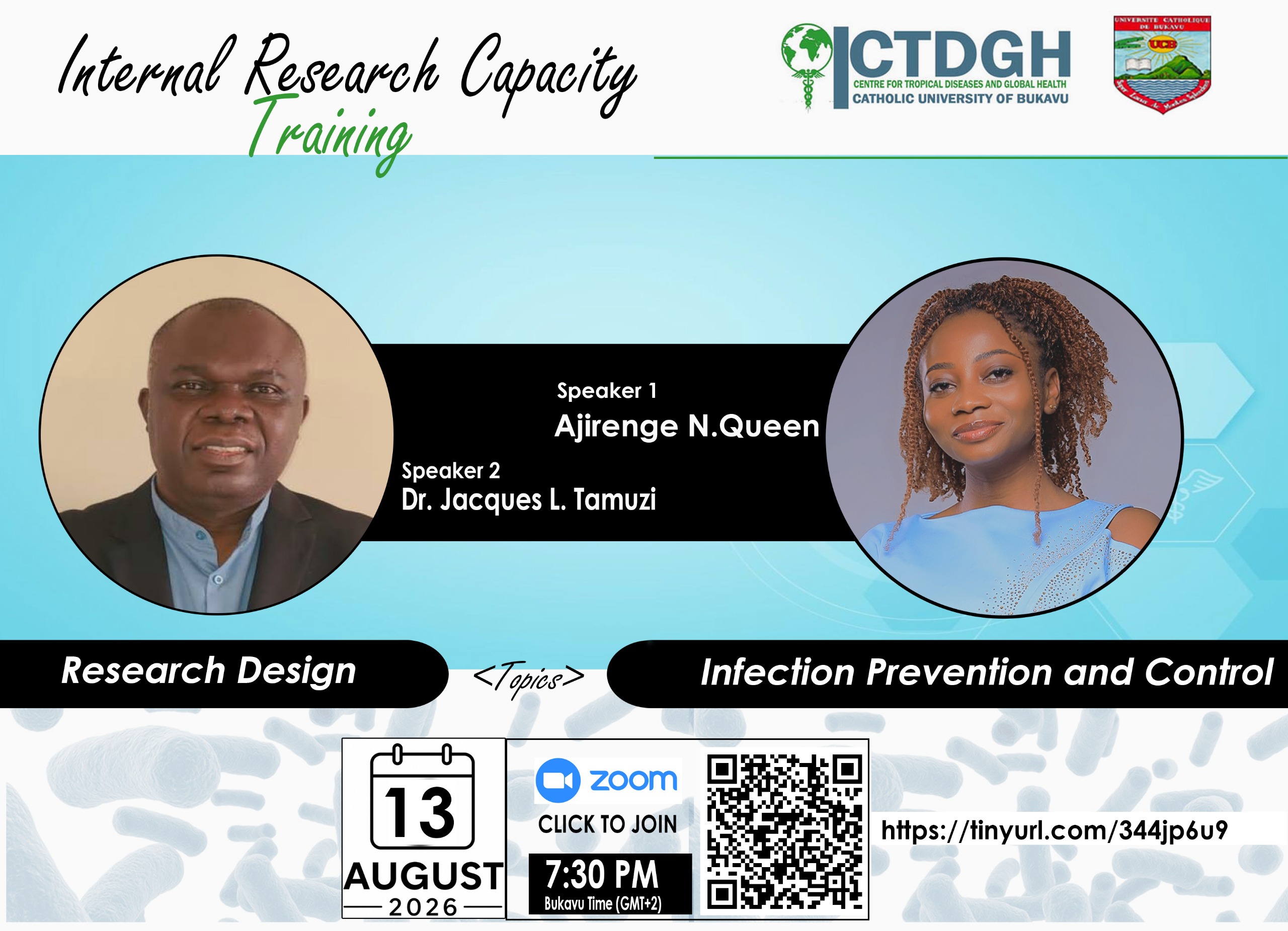
The upcoming session will bring together two complementary areas of expertise: Research Design and Infection Prevention and Control (IPC).
These topics are particularly relevant to CTDGH's multidisciplinary work in infectious diseases, epidemiology, global health, environmental health, and public health research.
Research Design
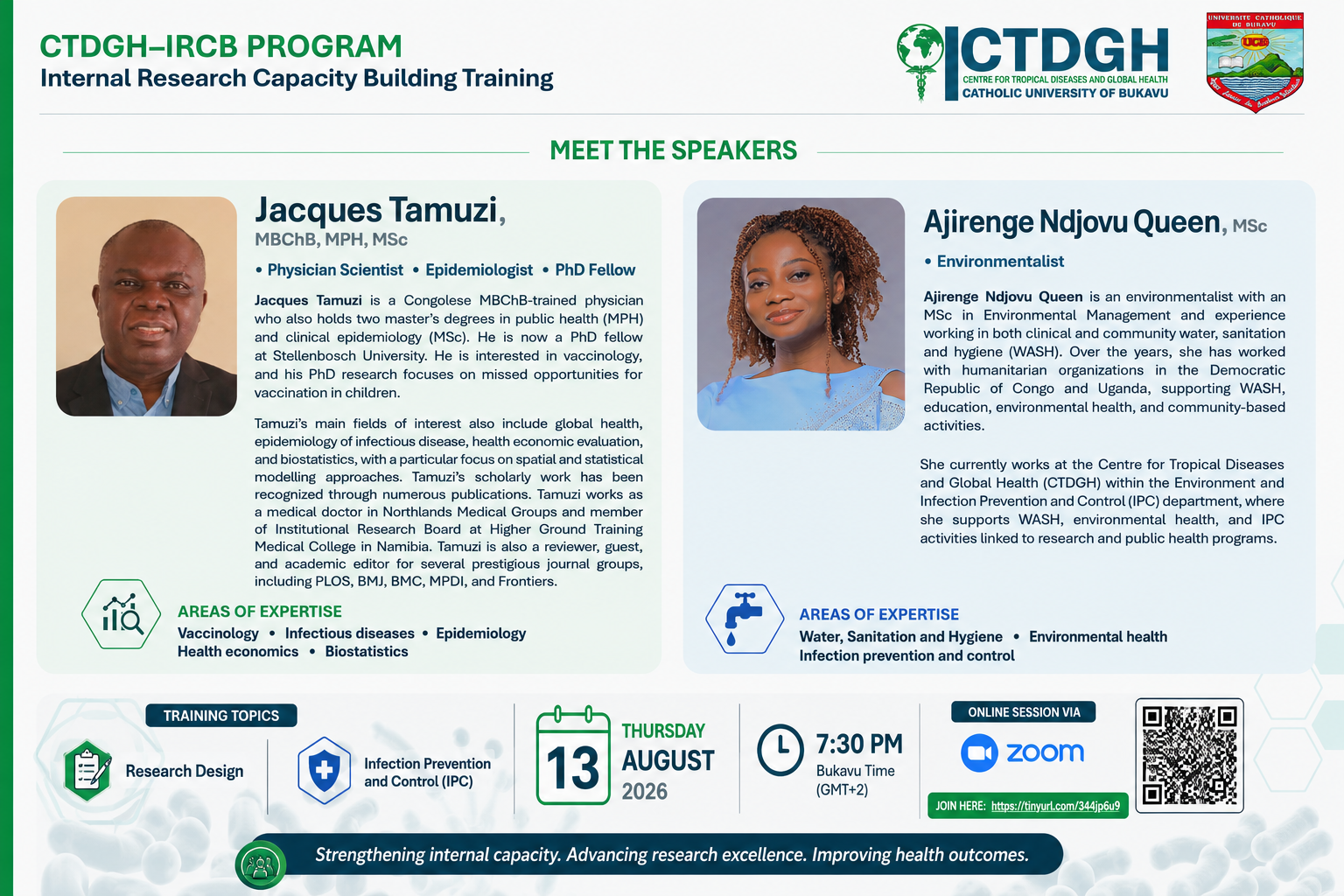
The session on Research Design will be facilitated by Dr. Jacques Tamuzi, MBChB, MPH, MSc, a physician scientist, epidemiologist, and PhD fellow.
Dr. Tamuzi is a Congolese physician with postgraduate training in Public Health and Clinical Epidemiology. He is currently pursuing PhD research at Stellenbosch University, with research interests including vaccinology and missed opportunities for vaccination among children.
His broader areas of interest include global health, infectious disease epidemiology, health economic evaluation, biostatistics, and spatial and statistical modelling. He has contributed to numerous scholarly publications and is involved in academic and scientific peer review.
Through this session, participants will have an opportunity to strengthen their understanding of the principles of research design and methodological decision-making, with a focus on developing research that is rigorous, relevant, and capable of generating reliable evidence.
Infection Prevention and Control
The second session will focus on Infection Prevention and Control (IPC) and will be facilitated by Ajirenge Ndjovu Queen, MSc, an environmentalist with expertise in environmental management, Water, Sanitation and Hygiene (WASH), environmental health, and IPC.
Ajirenge has professional experience working in clinical and community WASH settings and has supported humanitarian and public health activities in the Democratic Republic of Congo and Uganda.
She currently works at CTDGH within the Environment and Infection Prevention and Control Department, where she contributes to WASH, environmental health, and IPC activities linked to research and public health programmes.
Her contribution to the training will provide participants with an opportunity to explore the importance of IPC in protecting healthcare workers, researchers, study participants, and communities, while strengthening the connection between WASH, environmental health, IPC, and infectious disease prevention and control.
Why This Training Matters
Conducting high-quality health research requires more than technical knowledge alone. Researchers must be able to formulate appropriate research questions, select suitable study designs, collect reliable data, and apply appropriate analytical methods while ensuring that research activities are conducted safely and responsibly.
Similarly, effective infection prevention and control is essential for protecting research participants, healthcare workers, communities, and research teams, particularly in settings where infectious diseases pose significant public health challenges.
By bringing these two areas together, the training will encourage an integrated approach to scientific research, public health practice, and infection prevention.
Building Internal Expertise at CTDGH
The CTDGH–IRCB Program is designed to promote continuous professional development within the Centre by creating opportunities for staff members and researchers to learn from experts and from one another.
The programme also supports CTDGH's broader objective of developing sustainable local research capacity and strengthening the ability of its teams to generate high-quality evidence to inform public health action.
Through regular internal training sessions, CTDGH aims to build a multidisciplinary community of researchers and professionals equipped to address complex health challenges in the Democratic Republic of Congo and beyond.
Event Details
Event: CTDGH–IRCB Internal Research Capacity Building Training
Date: 13 August 2026
Time: 7:30 PM Bukavu Time (GMT+2)
Format: Online – Zoom
Training Topics
Research Design
Infection Prevention and Control (IPC)
Speakers
Dr. Jacques Tamuzi, MBChB, MPH, MSc
Physician Scientist • Epidemiologist • PhD Fellow
Ajirenge Ndjovu Queen, MSc
Environmentalist
CTDGH invites its researchers, staff, students, collaborators, and other interested members of the research and public health community to take part in this capacity-building session.
The training will provide an opportunity to learn from experienced professionals, exchange knowledge, strengthen research competencies, and engage in discussions around practical challenges in research and infection prevention and control.
Participants can join the online session through Zoom:
Date: 13 August 2026
Time: 7:30 PM (Bukavu Time, GMT+2)
Strengthening Capacity. Advancing Research. Improving Health.
The CTDGH–IRCB Internal Research Capacity Building Training is part of CTDGH's continuing investment in people and knowledge.
By strengthening the skills of researchers and public health professionals, CTDGH is contributing to the development of a stronger research ecosystem capable of producing relevant, rigorous, and locally grounded evidence for better health outcomes.
Join us on 13 August 2026 for this important learning and knowledge-sharing session.
The upcoming session will bring together two complementary areas of expertise: Research Design and Infection Prevention and Control (IPC).
These topics are particularly relevant to CTDGH's multidisciplinary work in infectious diseases, epidemiology, global health, environmental health, and public health research.
Research Design
The session on Research Design will be facilitated by Dr. Jacques Tamuzi, MBChB, MPH, MSc, a physician scientist, epidemiologist, and PhD fellow.
Dr. Tamuzi is a Congolese physician with postgraduate training in Public Health and Clinical Epidemiology. He is currently pursuing PhD research at Stellenbosch University, with research interests including vaccinology and missed opportunities for vaccination among children.
His broader areas of interest include global health, infectious disease epidemiology, health economic evaluation, biostatistics, and spatial and statistical modelling. He has contributed to numerous scholarly publications and is involved in academic and scientific peer review.
Through this session, participants will have an opportunity to strengthen their understanding of the principles of research design and methodological decision-making, with a focus on developing research that is rigorous, relevant, and capable of generating reliable evidence.
Infection Prevention and Control
The second session will focus on Infection Prevention and Control (IPC) and will be facilitated by Ajirenge Ndjovu Queen, MSc, an environmentalist with expertise in environmental management, Water, Sanitation and Hygiene (WASH), environmental health, and IPC.
Ajirenge has professional experience working in clinical and community WASH settings and has supported humanitarian and public health activities in the Democratic Republic of Congo and Uganda.
She currently works at CTDGH within the Environment and Infection Prevention and Control Department, where she contributes to WASH, environmental health, and IPC activities linked to research and public health programmes.
Her contribution to the training will provide participants with an opportunity to explore the importance of IPC in protecting healthcare workers, researchers, study participants, and communities, while strengthening the connection between WASH, environmental health, IPC, and infectious disease prevention and control.
Why This Training Matters
Conducting high-quality health research requires more than technical knowledge alone. Researchers must be able to formulate appropriate research questions, select suitable study designs, collect reliable data, and apply appropriate analytical methods while ensuring that research activities are conducted safely and responsibly.
Similarly, effective infection prevention and control is essential for protecting research participants, healthcare workers, communities, and research teams, particularly in settings where infectious diseases pose significant public health challenges.
By bringing these two areas together, the training will encourage an integrated approach to scientific research, public health practice, and infection prevention.
Building Internal Expertise at CTDGH
The CTDGH–IRCB Program is designed to promote continuous professional development within the Centre by creating opportunities for staff members and researchers to learn from experts and from one another.
The programme also supports CTDGH's broader objective of developing sustainable local research capacity and strengthening the ability of its teams to generate high-quality evidence to inform public health action.
Through regular internal training sessions, CTDGH aims to build a multidisciplinary community of researchers and professionals equipped to address complex health challenges in the Democratic Republic of Congo and beyond.
Event Details
Event: CTDGH–IRCB Internal Research Capacity Building Training
Date: 13 August 2026
Time: 7:30 PM Bukavu Time (GMT+2)
Format: Online – Zoom
Training Topics
Research Design
Infection Prevention and Control (IPC)
Speakers
Dr. Jacques Tamuzi, MBChB, MPH, MSc
Physician Scientist • Epidemiologist • PhD Fellow
Ajirenge Ndjovu Queen, MSc
Environmentalist
CTDGH invites its researchers, staff, students, collaborators, and other interested members of the research and public health community to take part in this capacity-building session.
The training will provide an opportunity to learn from experienced professionals, exchange knowledge, strengthen research competencies, and engage in discussions around practical challenges in research and infection prevention and control.
Participants can join the online session through Zoom:
Date: 13 August 2026
Time: 7:30 PM (Bukavu Time, GMT+2)
Strengthening Capacity. Advancing Research. Improving Health.
The CTDGH–IRCB Internal Research Capacity Building Training is part of CTDGH's continuing investment in people and knowledge.
By strengthening the skills of researchers and public health professionals, CTDGH is contributing to the development of a stronger research ecosystem capable of producing relevant, rigorous, and locally grounded evidence for better health outcomes.
Join us on 13 August 2026 for this important learning and knowledge-sharing session.